

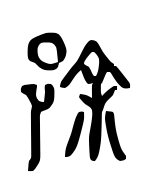
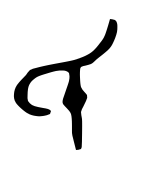
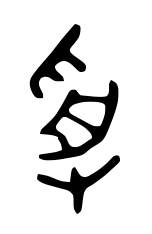
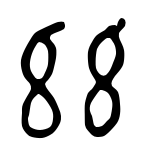
譯文
译文
Translation
注釋
注释
Annotations
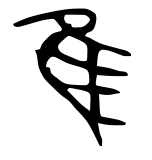
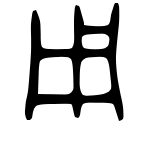
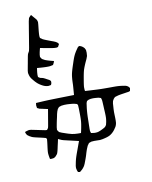
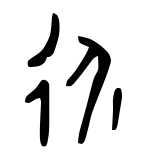
- 1.隹 讀若「唯」。文言發語詞。
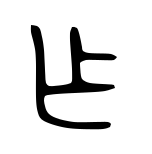
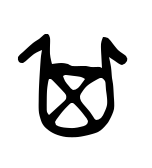
- 2.既生霸 西周紀月之術語。「霸」同「魄」,指月之光輝。「既生霸」意謂新月伊始,光華漸盈之吉日,約當夏曆每月月初上弦前後。
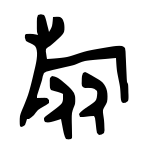
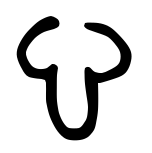
- 3.隻茲 隻,即「獲」字。茲,此也。意謂徐氏獲此之竹材。
- 1.隹 通“唯”,发语词。
- 2.既生霸 西周纪月术语。霸,通“魄”,指月光。既生霸指新月始生光辉的吉日,约为农历月初上弦前后(西元 2026 年 5 月 23 日正值农历四月初七上弦月)。
- 3.隻 今作“获”。
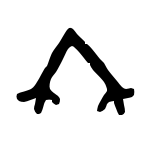
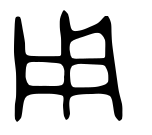
- 4.茲 今作“兹”。
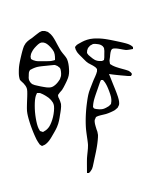
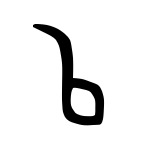
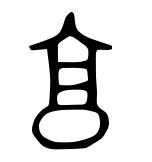
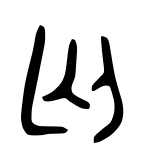
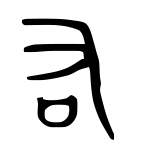
- 1.隹 (zhuī) read as wéi (唯) "Verily; it is thus / here begins."
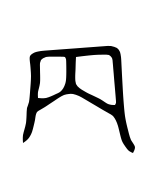
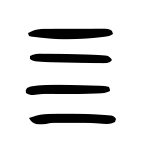
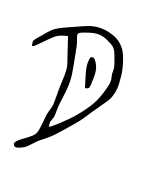
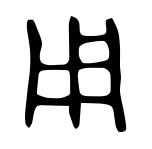
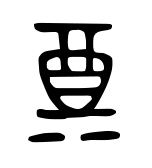
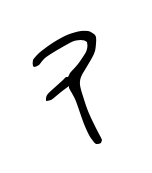
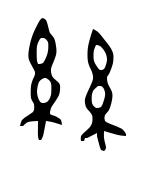
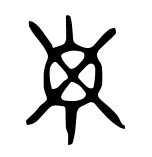
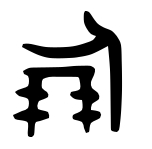
Formally written in its authentic paleographic form as the pictograph of a short-tailed bird (zhuī), this graph functions as the classic phonetic loan for wéi (唯/维), the canonical initial particle deployed to inaugurate bronze inscriptions. - 2.丙午四月既生霸丁酉 (Bǐngwǔ sìyuè Jìshēngbà Dīngyǒu) "In the fourth lunar month of the Bǐngwǔ year, during the Jìshēngbà phase, on the Dīngyǒu day."
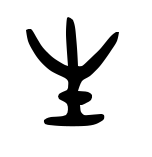
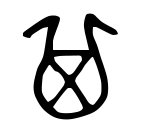
A chronological formula synthesizing the Sexagenary Cycle (gānzhī 干支) with archaic lunar phase terminology. While authentic Western Zhou epigraphy typically anchors chronology around a ruler's regnal year, this text adopts the rotating stem-branch matrix to record the specific year (Bǐngwǔ) and day (Dīngyǒu), overlaying the Western Zhou lunar marker Jìshēngbà.
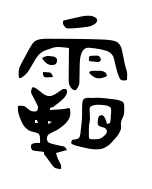
Phonologically, bà (霸) serves as a loan for pò (魄), denoting the reflective light of the moon. Under the mainstream four-quarter chronological framework, Jìshēngbà ("after the birth of the lunar light") designates the first quarter phase, spanning roughly from the seventh or eighth to the fourteenth or fifteenth day of the lunar month—aligning with the modern Gregorian date of this inscription (23 May 2026), which corresponds to the seventh day of the fourth lunar month, the night of the waxing first-quarter moon.
譯文
译文
Translation
注釋
注释
Annotations
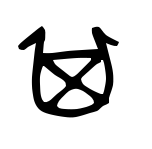
- 1.乍旅竹 乍,即「作」字。古器铭文常鑄「作旅鼎」、「作旅簋」,其「旅」字寓有雙重義理:一曰行旅,表器物輕便可隨身攜行;二曰眾多,表此器非一人私暱,乃用以款待眾人、流傳於社群同好之間。
- 2.奠厥絲 奠,安放、使之穩固也。絲,金文無「繩」字,此處引申指繫綁之繩。意謂以竹節為繩道樞紐,使錯落之繩得以安穩交織。
- 3.束其身、妥其心 束,圍繞、包覆也。妥,通「綏」,安撫、使之安寧也。此句精妙捕捉了繩縛中獨特之「軀體經驗」:當身體之形體在經緯交織中獲得明確之邊界與支撐(束其身),外在喧囂隨之沉落,內心反而因絕對之信任而獲得安穩與寧靜(妥其心)。
- 1.乍 通“作”,制作。
- 2.旅竹 旅,西周金文重器中常见“作旅簋”、“作旅鼎”,此处的“旅”兼具“行旅/便携”与“众人/社群”双重含义。“旅竹”即指供社群同好共同执用、流转分享的便携竹质缚具。
- 3.奠 动词。安置、固定、使稳固。
- 4.厥 代词。其、它的。
- 5.絲 今作“丝”。金文无“绳”字,此处引申为所使用的绳索。
- 6.束 动词。约束、环绕、包覆。此处指绳竹对身体线条的妥帖规范与支撑。
- 7.妥 金文多以此字表“安妥”。后世多通假为“绥”,意为安抚、使安宁。此处用作使动用法,意在抚平思绪,使内心归于安宁平稳。
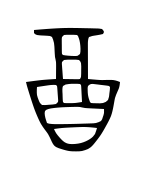
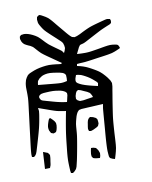
- 1.用 (yòng) "To use; thereby / by means of which"
- 2.旅竹 (lǚ zhú) Literal translation as "The traveling bamboo"
This compound adapts the epigraphic conventions of ritual bronzes, where lǚ (旅) frequently designates objects crafted for travel, military expeditions, or collective clan use (e.g., zuò lǚ guǐ 作旅簋).
Paleographically, the character encapsulates both spatial displacement and structured organization — referring to the physical act of journeying (e.g., lǚtú 旅途) as well as an assembled group of people (e.g., lǚbàn 旅伴). Coupled with bamboo, the phrase marks both the geographic movement of the material and the shared lineage of the community interacting with it. - 3.奠厥丝 (diàn jué sī) "To secure [or anchor] this cord"
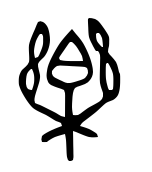
The verb diàn (奠) functions in its epigraphic sense, meaning "to set down, establish, or firmly stabilize." The pronoun jué (厥) serves as the archaic possessive marker ("this/its"). The character sī (丝, silk/thread) operates as a semantic extension for a rope or cord. In the bronze script of the Western Zhou period, the character for shéng (繩, rope) had not yet emerged; thus, the character sī (絲) is deployed in its stead to denote the rope used in Shibari. - 4.束其身 (shù qí shēn) "To bind [or constrain] the body"
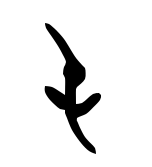
The verb shù (束) operates in its foundational epigraphic sense; its early graph depicts a bundle of wood bound tightly by a cord, which semantically expanded to mean "to bind, encircle, or bundle." The particle qí (其) functions as the definitive pronoun ("the/its"), modifying shēn (身, body). - 5.妥其心 (tuǒ qí xīn) "To pacify [or anchor] the mind-heart"
The verb tuǒ (妥) is deployed in its original epigraphic sense of stabilizing or bringing to rest; its early graph depicts a hand (zhuǎ 爪) placed gently over a kneeling woman (nǚ 女), signifying the act of bringing composure or security to a subject. The particle qí (其) modifies xīn (心). In early Chinese thought, xīn represents not merely the physical organ, but the unified locus of consciousness, emotion, and intellect.
譯文
译文
Translation
注釋
注释
Annotations
- 1.享倗友 倗,即「朋」字。享,奉獻、款待也。古文中「享」字本具饗宴之義,意謂以此藝具作為與同好結緣、交付信任之媒介。
- 2.匃 同「丐」,祈請、求取也。
- 3.屯右 讀若「純佑」。屯,通「純」,大也;右,通「佑」,神明右助也。古人以右為尊,神祐其右,故謂之右。屯右意謂極大且純粹之神祐。
- 4.萬秂永用 此為周代鐘鼎彝器最經典之末尾嘏辭(祝願語)。器物雖有形,而其承載之信任、記憶與技藝可跨越世代。此處寄寓了作者至深之期許,願此器不落塵俗,長久為後世慧眼者所珍愛、摩挲與安全執用。
- 1.享 动词。宴请、款待、奉献。金文中以此字直接表飨宴之意。
- 2.倗友 今作“朋友”。
- 3.匃 动词。同“丐”,祈求、乞求(福泽)。
- 4.屯右 读作“纯佑”。屯,通“纯”,大也、纯正无瑕也;右,通“佑/祐”,指神明在右侧提供护佑与协助。“屯右”即指极大且纯正的庇佑。
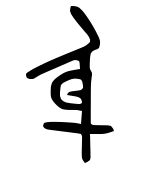
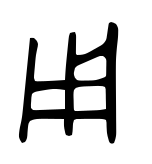
- 5.秂 今作“年”。
- 6.永 副词。长久地、永远地。金文“永”字像水流长长源源不断之形。
- 1.享倗友 (xiǎng péng yǒu) "To dedicate and share with companions of the community"
The verb xiǎng (享) is employed in its foundational ritual sense. In early scripts, the graph depicts a sacrificial pavilion, originally signifying the presentation of ritual offerings, which later expanded to encapsulate communal reciprocity — specifically the act of hosting or sharing the utility with peers. The object péng-yǒu (倗友 / 朋友) denotes the interconnected nodes and companions of the community. - 2.康樂 (kāng lè) "Vibrant health, peace, and harmonious joy"
A classic benedictory compound frequent in late Western Zhou epigraphy. The character kāng (康) exhibits an early graph depicting grains separating from a winnowing basket, semantically expanding from agricultural abundance to denote physical well-being and tranquility. The character lè (樂, read as yuè in its musical origin) in its origin depicts silk strings stretched over a wooden frame — a musical instrument — signifying social harmony and shared celebration.
Conjoined, kāng-lè operates as a liturgical blessing invoking both individual physical vitality and the harmonious alignment of the collective. - 3.屯右 (tún yòu) read as chún yòu (純佑) "Grand and unblemished protection."
A classic benedictory formula standard in Western Zhou epigraphy. The character tún (屯, a pictograph of a germinating sprout) serves as a phonetic loan for chún (純), signifying "grand and unblemished." The character yòu (右, a pictograph of a right hand) functions as the classic loan for yòu (佑/祐), embodying the spatial and ritual concept of guardianship positioned at one's right side.
Conjoined, the compound operates as a liturgical invocation, requesting an enduring, untainted aura of protection for the community. - 4.萬秂永用 (wàn nián yǒng yòng) "May it be eternally treasured and utilized for ten thousand years."
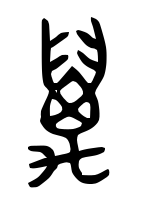
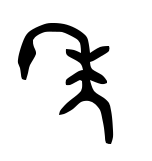
The closing phrase traditionally carved into ancient bronzes. Here, wàn-nián (万年, literally "ten thousand years") functions as a figurative term invoking absolute eternity. In the original text, the word for "year" is written in its archaic paleographic form, 秂, which combines 禾 (ripe grain) atop 人 (a person)—vividly depicting a human being carrying a bountiful harvest on their back, a meaning that later expanded to denote the annual cycle of seasons. Paleographically, the character yǒng (永) similarly evolved from depicting the long, continuous flow of a stream to mean "forever" or "eternity."
Combined, it represents a deep desire for this object to be cared for and thoroughly used across that endless span of time. The inscription flows into its final yòng (用, to use), because the life of this bamboo isn't found in keeping it untouched on a shelf, but in the continuous act of touching it, tying it, and keeping it alive within the shared social space.
跋
跋
跋 / Afterword
本銘依西周中期青銅器金文之體例擬作。
夫金文者,歷三千載之鐘鼎文字也。古人信金石不朽,方托功烈與契盟於重器,以求文字長存於天地之間。
將去悉尼,感風物之包容、結同好之深厚,作此旅竹,饗眾人焉。唯願繩縛之絆,絕山川之阻、共日月之光。
本铭依西周中期青铜器金文之体例拟作。
夫金文者,历三千载之钟鼎文字也。古人信金石不朽,方托功烈与契盟于重器,以求文字长存于天地之间。
将去悉尼,感风物之包容、结同好之深厚,作此旅竹,饗諸好焉。唯愿绳缚之绊,绝山川之阻、共日月之光。
This inscription emulates the stylistic formula and orthography found on ritual bronze vessels from the mid-Western Zhou dynasty.
Jīnwén (金文, Bronze Inscriptions) refers to the characters cast and inscribed upon bells and cauldrons, spanning three millennia. Believing that metal and stone endure, the ancients entrusted their achievements and covenants to these sacred vessels, seeking to preserve their words forever between heaven and earth.
As I'm leaving Sydney, deeply moved by the inclusive spirit of this land and bound to the profound fellowship of my peers, I crafted this bamboo as an offering to the community. May the connections forged through rope defy the barriers of mountains and seas, and shine as one with the sun and moon.
關於
关于
About
歡迎前往 Fetlife 評論區留下你與這根「旅竹」的故事
欢迎前往 Fetlife 评论区留下你与这根「旅竹」的故事
Welcome to share your story with this bamboo in the Fetlife comment section.
Made by Tim with ❤️
Made by Tim with ❤️
Made by Tim with ❤️